iDMA
What iDMA Is
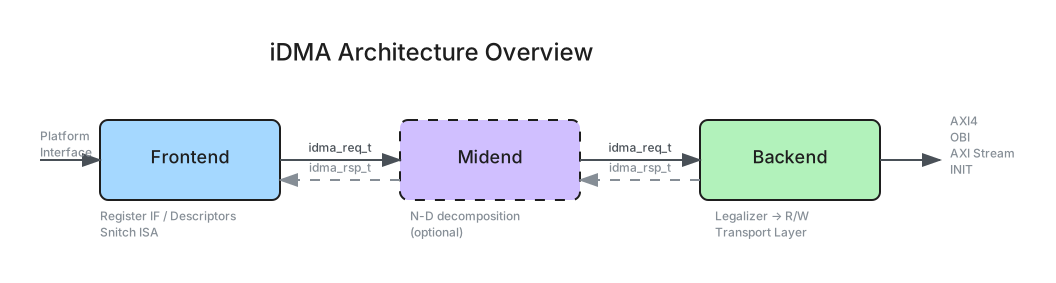
iDMA moves data between memories and peripherals across different bus protocols (AXI, OBI, TileLink) and supports multi-dimensional transfers. It splits the problem into three layers so you can mix and match integration styles without changing the core engine.
- Frontend: software-visible interface for requests (selectable register interface, Snitch ISA, descriptor rings).
- Midend: optional ND/RT decomposition and multicore split.
- Backend: protocol execution on the bus, with optional on-the-fly compute.
Start Here
If you are integrating iDMA into an SoC, read these in order:
If you are deep-diving the design:
Supported Protocols
The backend supports these protocols via protocol_e in idma_pkg.sv:
| Enum Value | Protocol | Description | Typical Use |
|---|---|---|---|
| 0 | AXI | Full AXI4 | Main memory, high bandwidth |
| 1 | OBI | OBI | Simple peripherals, low area |
| 2 | AXILITE | AXI4-Lite | Register access |
| 3 | TILELINK | TileLink-UH | TL-based SoCs (via TLToAXI4) |
| 4 | INIT | Init protocol | Efficient zeroing (Occamy) |
| 5 | AXI_STREAM | AXI Stream | Streaming endpoints |
On-the-Fly Compute
The backend can optionally transform data as it moves, in the transport datapath, with no extra memory traffic. One operation is applied per transfer:
- Transpose: tiled matrix transpose (
idma_otf_transpose). - MX quantize / dequantize: OCP microscaling between FP32/FP16 and MXFP8 (E5M2 elements with an E8M0-labelled block scale, 32-element / 33 B blocks). These are size-changing transfers, legalized in the legalizer.
Enabled via EnableCompute plus a per-op ComputeOps mask. See
Compute.
Code Generation (High Level)
iDMA uses the MARIO generator to produce protocol-specific RTL from templates and YAML capability databases. This is how a single codebase produces many backend variants.
Key locations:
src/db/*.yml- protocol capability databasessrc/backend/tpl/- backend templatessrc/frontend/reg/tpl/- register frontend templatesutil/gen_idma.py- generator entry pointutil/mario/- generator modules
Where to Find Details
- Full data type definitions: Interfaces and Types
- Performance constraints and tradeoffs: Performance and Limitations
- Testbench and job files: Verification
- Documentation QA checklist: Docs Verification Plan